MenuAction
-
class
pygamelib.gfx.ui.MenuAction(title: pygamelib.base.Text = None, action=None, parameter=None, padding: int = 1, config: pygamelib.gfx.ui.UiConfig = None)¶ Bases:
objectA menu action is a menu entry that executes a callback when activated. Usually a Menuaction represents an action from the user interface like open file, save, quit, etc.
Therefor a MenuAction is fairly simple, at its simplest it has a title and a callable reference to a function.
An action cannot be used by itself but can be added to a
MenuBaror aMenu.Like everything in the UI module, MenuAction are styled through a
UiConfigobject. Unlike the other classes of that module however, the configuration object is not mandatory when instanciating this class. The reason is that theMenuBarobject impose the configuration to its managedMenuActionandMenu.-
__init__(title: pygamelib.base.Text = None, action=None, parameter=None, padding: int = 1, config: pygamelib.gfx.ui.UiConfig = None) → None¶ The constructor takes the following parameters.
Parameters: - title (str |
Text) – The title of the action (i.e: its label) - action (callable) – A reference to a callable function that is going to be executed when the action is activated. If set to None, nothing will happen when the action is activated.
- parameter (Any) – A parameter that is passed to the callback action if not None.
- padding (int) – The horizontal padding, i.e the number of space characters added to the left and right of the action.
- config (
UiConfig) – The configuration object.
Example
menubar = MenuBar(config=UiConfig.instance())
file_menu = Menu(
    "File",
    [
        MenuAction("Open", open_file),
        MenuAction("Save", save_file),
        MenuAction("Save as", save_file_as),
        MenuAction("Quit", exit_application),
    ]
)
menubar.add_entry( file_menu )
menubar.add_entry( MenuAction("Help", display_help) )
screen.place(menubar, 0, 0)
screen.update()
- title (str |
Methods
__init__(title[, action, parameter])The constructor takes the following parameters. activate()Execute and return the result of the callback. render_to_buffer(buffer, row, column, …)Render the object from the display buffer to the frame buffer. title_width()Return the actual width of the action’s title. Attributes
actionGet / set the action’s callback, it needs to be a callable. configGet / set the config of the MenuAction, it needs to be a UiConfig.paddingGet / set the padding before and after the menu action, it needs to be an int. selectedGet / set the selected of the MenuAction, it needs to be a boolean. titleGet / set the title of the action, it needs to be a str or a Textobject.-
action¶ Get / set the action’s callback, it needs to be a callable.
-
activate()¶ Execute and return the result of the callback.
Example:
file_save_action.activate()
-
padding¶ Get / set the padding before and after the menu action, it needs to be an int.
-
render_to_buffer(buffer, row: int, column: int, buffer_height: int, buffer_width: int) → None¶ Render the object from the display buffer to the frame buffer.
This method is automatically called by
pygamelib.engine.Screen.render().Parameters: - buffer (numpy.array) – A screen buffer to render the item into.
- row (int) – The row to render in.
- column (int) – The column to render in.
- height (int) – The total height of the display buffer.
- width (int) – The total width of the display buffer.
-
selected¶ Get / set the selected of the MenuAction, it needs to be a boolean.
This changes the representation (way it’s drawn) of the menu entry.
-
title¶ Get / set the title of the action, it needs to be a str or a
Textobject.The title is used in the
Menu. In the following image, the title of the first action in the expanded menu is “Open”, followed by “Save”.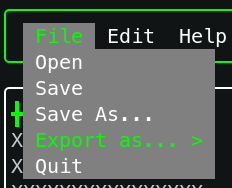
-
title_width()¶ Return the actual width of the action’s title. This takes into account the padding.
Example:
menu_action.title_width()
-